Guitar Tablature vs. Standard Notation
A war has existed for five hundred years among guitarists about how best to read music. Standing on opposite sides of this terrible and ceaseless conflict are the camps of Tablature versus Standard Notation. These two parties have been slinging mud at each other for longer than the modern guitar has existed, but as of the last century or so, Tablature has come to dominate what most guitarists put on their music stands. An aspiring guitarist will miss out on a lot by only relying on Tablature, and this post will serve as a brief history and overview of both systems of music writing, and why a student should pick up Standard Notation in the long run.
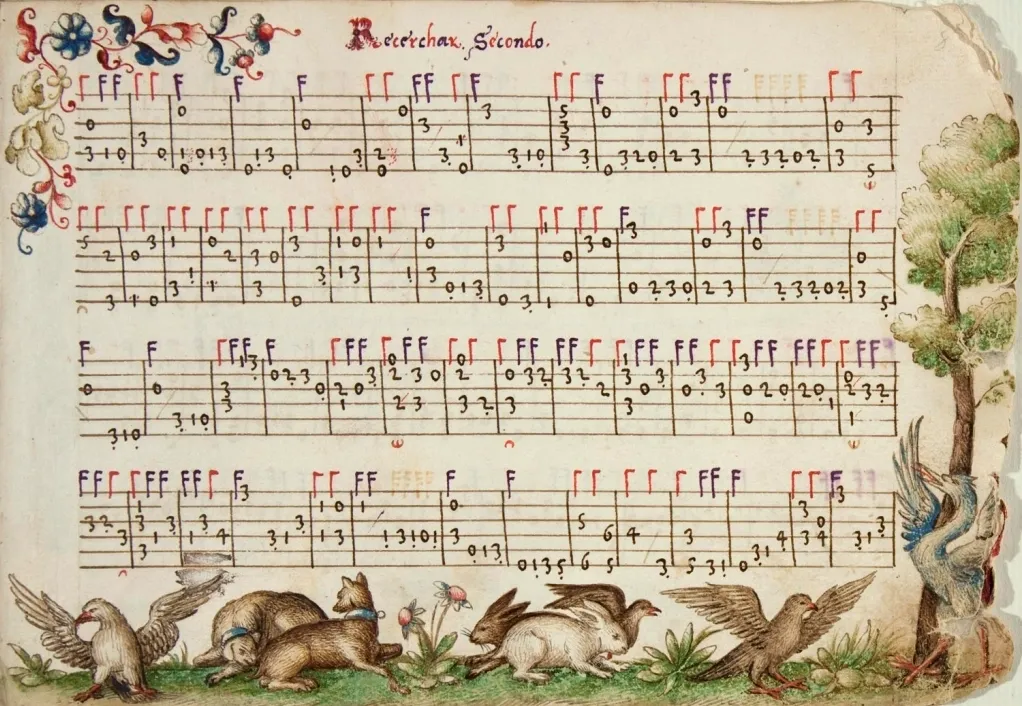
Tablature, or TAB for short, has existed in its modern form for as long or longer than what we consider “modern” Standard Notation. The header image for this post comes from the 1520 Capirola Lutebook, and is practically indistinguishable from modern tablature, though oriented upside down from how we read TAB today. Indeed, if you tune your G string down a half-step, you can read it just as is.
The benefits of reading TAB are as obvious as the system itself; It can be learned in a matter of minutes, and immediately be used to read music with no other information required. It provides a visual and intuitive way to pick things up quickly.
Standard Notation is far more abstract than TAB, with notes aligned vertically to measure how high or low pitched the note sounds, and with each position on the musical staff given a letter name from A to G. To be frank, Standard Notation is a brick wall for a first time reader, and is made worse by the fact that the guitar is one of the most complicated instruments on which to read. Unlike a piano, for instance, which has only one version of any given note in a particular octave, the guitar gives you many different choices for where to play a given note. Take this musical example:
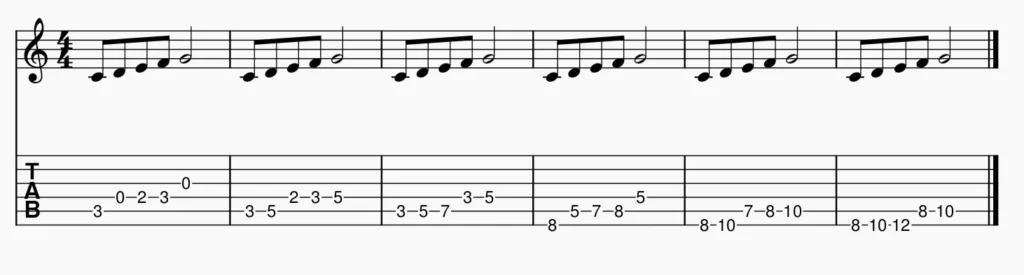
You can play this simple passage of music in six different places on the guitar, and there are more besides! So why then is it a good idea to learn to read Standard Notation on the guitar? There are many reasons, in fact, but chief among them is that learning to read music lets you actually understand what it is that you’re playing. You can see which notes go where and how they sit on the guitar in relation to each other, you can start to draw patterns out of things to reinforce your technique and memory, and you can think more deeply about how music works in a way that opens the door for you to write music of your own.
You see, Tablature has many drawbacks – It’s bad at notating rhythm, it can be hard to memorize music using the system, and reading chords in TAB can be visually overwhelming. The biggest shortfall of the system is conceptual, though: Tablature tells you how to play something, but it does not tell you _what you are playing. _More specifically it tells you how some guy on the internet thinks you should play something. But as we’ve seen above, there are many different places to play a given musical line. If you understand the music, you can choose the best place on the guitar to play it yourself, and not be reliant on the potentially dubious choices of others.
Music is a collaborative process, and though solo music exists, communication is a vital skill for any guitarist. The pianist in your band has no idea what the seventh fret of the fourth string is. Your saxophonist wants you to change your bass note from a G to an F#; do you know what that means if all you have is the fret numbers? Learning to read music will open many doors that would be shut for want of that knowledge. While knowing Tablature is important, since many modern guitar songs have only ever been figured in TAB, many styles are almost entirely written in Standard Notation; Classical, Jazz, and Theatre music are all rooted in Standard Notation (and not for nothing but those are the gigs that tend to actually pay you). In addition, for those wanting to pursue music in higher education, it’s a good idea to learn how to read music before you have to worry about college entrance auditions – Trust me.
So when you’ve just started playing the guitar, and you’re working through your TAB sheets, pay some mind to the notation as well. You’ll be very glad you did in a few weeks time.
Interested in learning more? Sign up for a free introductory private lesson with one of our guitar teachers at this link https://evergreenmusicschool.mymusicstaff.com/free-introductory-private-lesson
Sign Up for Blog Updates!
Join my email list to receive updates and information.